Renew Health Blog 💭
Practical Pelvic Floor Thoughts from Your Experts at Renew Health
Running With Pelvic Floor Symptoms? You’re Not Broken.
Running With Pelvic Floor Symptoms? You’re Not Broken.
If you’ve ever noticed leaking, heaviness, or pelvic pressure while running, let’s start here:
you are not broken, and you are not alone.
These symptoms aren’t a sign that you have to stop running or give up the activities you love. They’re your body’s way of asking for support, coordination, and better load management—not more willpower or endless squeezing.
And despite what you may have been told, the answer is rarely “just do your Kegels.”
At Renew Health, we work with runners every day who are strong, motivated, and doing “all the right things,” yet still experiencing pelvic floor symptoms. What they usually need isn’t more strength—it’s better timing, coordination, and whole-body support under impact.
Let’s break down why pelvic floor symptoms show up with running and what actually helps.
1. Your Pelvic Floor Doesn't Just Need More Strength--It Needs Coordination
Your pelvic floor doesn’t work in isolation. It’s part of an integrated pressure system that includes your diaphragm, deep abdominal muscles, rib cage, hips, and nervous system.
Running adds impact and load. If any part of this system isn’t coordinating well under stress, symptoms like leaking or pressure can appear—even in very strong runners.
Common factors that disrupt coordination include:
Poor pressure management (breath holding, bracing, or gripping through the abs, glutes, or jaw)
Hormonal changes (postpartum, perimenopause, menopause)
Constipation or chronic dehydration
Old injuries or movement compensations (especially from the foot, ankle, hip, or spine)
This is why pelvic floor symptoms are rarely fixed by strengthening one muscle group in isolation.
2. Your Pelvic Floor Responds to the Whole Body Chain
Running is a full-body activity. Every step sends force from the ground, through your foot and ankle, up into your hips, pelvis, spine, and rib cage.
Your pelvic floor is designed to adapt to this force, not fight it.
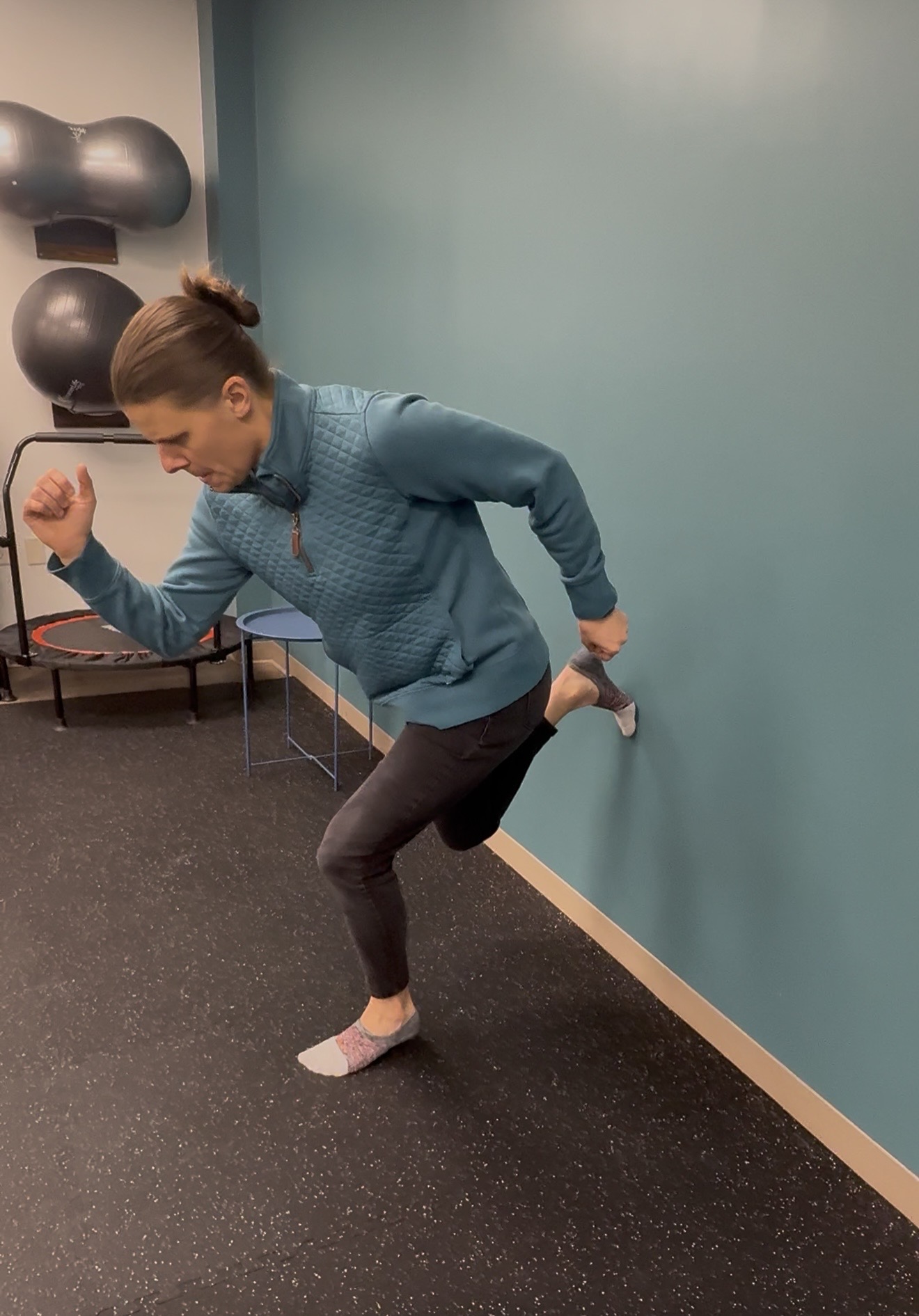
During a normal running stride, your body moves through two key phases:
Load Acceptance (Mid-Stance)
The foot pronates (flattens)
The ankle bends forward
The hip moves slightly inward
The pelvic floor lengthens and widens
This allows your body to absorb impact and support your organs.
Push-Off (Propulsion)
The foot stiffens
The hip rotates outward
The pelvic floor recoils and lifts
This creates a strong, efficient push without overloading your low back or pelvic floor.
If your body can’t access these movements smoothly—often due to stiffness, weakness, or protective tension elsewhere—it will compensate. Over time, that compensation can show up as leakage, pressure, or pain.
3. Hip Mobility and Why It's Important
That persistent tightness in your hips or outer thigh isn’t random.
Many runners are told they have “tight hip flexors” or “IT band issues,” but what we often see is limited hip motion during load acceptance. When the hip can’t move well, nearby tissues overwork to stabilize.
Those muscles feel tight because they’re doing too much.
Instead of stretching endlessly, many runners benefit more from:
Improving hip mobility where motion is missing
Strengthening through full, controlled ranges
Improving foot and ankle responsiveness
Stacking the rib cage over the pelvis without clenching
Mobilizing the thoracic spine and rib cage
This approach helps the body share load more efficiently—so the pelvic floor doesn’t have to overwork.
4. Yes, Your Rib Cage and Breathing Matters (A Lot)
Your rib cage and pelvic floor move together.
If your ribs are flared forward or compressed in the back, pressure management becomes harder—especially during impact activities like running.
Helpful strategies include:
Practicing long, controlled exhales (for example: 4 steps in, 6 steps out)
Improving thoracic spine mobility
Strengthening obliques and serratus anterior
Learning to expand the rib cage without gripping through the abs or glutes
Better rib cage mechanics = better pelvic floor response.
Ready to run stronger and symptom-free? We're ready to help right in East Longmeadow, MA.
At Renew Health, we help runners build resilience through smart strength training, efficient movement patterns, and breath-supported pacing strategies. We understand the real challenges runners face—from fatigue and recurring aches to difficulty tolerating mileage—and we create individualized plans that improve durability, efficiency, and confidence so you can run consistently without flare-ups or setbacks.👉 Book an evaluation today and learn personalized strategies.
📍 Renew Health – East Longmeadow, MA

Contact Us
Phone: (413) 224-6657
Fax: (413) 273-8203
Email: [email protected]
280 N. Main Street Suite 10A, East Longmeadow, MA 01028
Hours of Operation
Monday - Thursday: 7:00am - 7:00pm
Friday - 7:00am - 4:00pm
